Koreksi Pasal 23
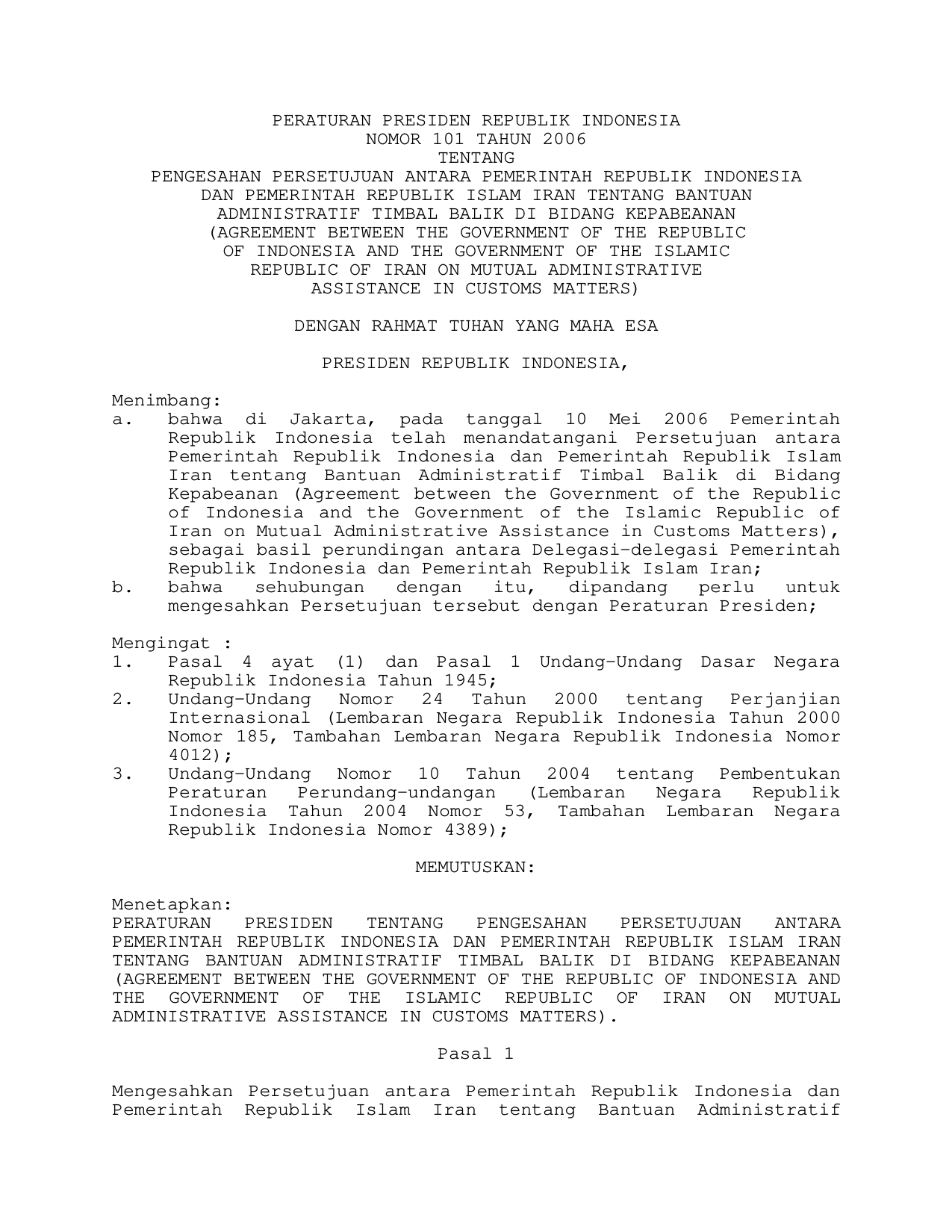
PERPRES Nomor 101 Tahun 2006 | Peraturan Presiden Nomor 101 Tahun 2006 tentang PENGESAHAN PERSETUJUAN ANTARA PEMERINTAH RI DAN PEMERINTAH REPUBLIK ISLAM IRAN TENTANG BANTUAN ADMINISTRATIF TIMBAL BALIK DI BIDANG KEPABEANAN (AGREEMENT BETWEEN THE GOVERNMENT OF THE REPUBLIC OF INDONESIA AND THE GOVERNMENT OF THE ISLAMIC REPUBLIC OF IRAN ON MUTUAL ADMINISTRATIVE ASSISTANCE IN CUSTOMS MATTERS)
Teks Saat Ini
Jangka Waktu dan Pengakhiran
1. Persetujuan ini akan terus berlaku untuk periode 5 (lima) tahun dan akan diperpanjang secara otomatis untuk jangka waktu yang sama secara terus menerus, kecuali Para Pihak bermaksud untuk mengakhirinya dengan menyampaikan pemberitahuan tertulis kepada Pihak lainnya sekurang-kurangnya 6 (enam) bulan sebelum Persetujuan berakhir.
2. Persetujuan ini dapat direvisi atau diamandemen dengan merujuk kepada Pasal 22 melalui kesepakatan bersama dari Para Pihak.
3. Pengakhiran Persetujuan ini tidak akan mempengaruhi berakhirnya kegiatan atau program yang dilaksanakan berdasarkan Persetujuan ini.
Sebagai bukti, yang bertandatangan di bawah ini, yang diberi kuasa oleh Pemerintah masing-masing, telah menandatangani Persetujuan ini.
Dibuat dalam rangkap dua di Jakarta pada tanggal sepuluh bulan Mei tahun dua ribu enam, dalam bahasa INDONESIA, Persia dan Inggris, semua naskah mempunyai nilai otentik yang sama. Dalam hal terjadi perselisihan penafsiran atas Persetujuan ini, maka naskah dalam bahasa Inggris yang berlaku.
Untuk Pemerintah Untuk Pemerintah
Republik Islam Iran ttd.
ttd.
Sri Mulyani Indrawati Dr. Mohammad Soleimani Menteri Keuangan Menteri Komunikasi dan Teknologi Informasi TAMBAHAN PRINSIP-PRINSIP DASAR PERLINDUNGAN DATA
1. Data Pribadi yang melalui proses otomatis harus :
(a) didapat dan diproses secara wajar dan berdasarkan hukum;
(b) disimpan untuk tujuan-tujuan khusus dan sah, dan tidak digunakan untuk tujuan-tujuan yang tidak sesuai dengan itu;
(c) memadai, relevan, dan tidak terlalu berlebihan dalam hubungannya dengan tujuan penyimpanan data tersebut;
(d) akurat, dan bilamana dibutuhkan, selalu diperbaharui;
(e) dipelihara dalam suatu bentuk yang membolehkan identifikasi data dimaksud untuk dihapuskan jika sudah tidak berguna untuk disimpan.
2. Data pribadi yang mengungkap latar belakang ras, opini politik atau keagamaan, atau kepercayaan lainnya, sebagaimana juga data pribadi mengenai kesehatan atau kehidupan seksual, tidak dapat diproses secara otomatis, kecuali hukum nasional menyediakan perlindungan yang memadai. Hal yang sama juga berlaku terhadap data pribadi yang berhubungan dengan tuduhan kriminal.
3. Tindakan keamanan yang memadai harus diambil sebagai perlindungan terhadap data pribadi yang disimpan didalam file data otomatis untuk menghindari perusakan yang tidak sah atau hilang secara tidak sengaja, juga terhadap akses yang tidak sah, pengubahan, atau penyebaran secara tidak sah.
4. Setiap orang harus dapat :
(a) menjaga keberadaan file data otomatis, tujuan dari data tersebut, begitu juga identitas dan kebiasaan, tempat tinggal atau kantor utama kegiatan bisnis orang yang mengendalikan file;
(b) memperoleh data pribadi yang berhubungan dengannya, baik yang disimpan dalam file data otomatis maupun komunikasi data dalam bentuk yang masuk akal, dalam periode waktu yang wajar dan tanpa penundaan yang berlebihan atau tanpa konfirmasi yang membutuhkan biaya.
(c) memperoleh, jika terjadi, pembetulan atau penghapusan data jika data tersebut telah diproses bertentangan dengan hukum nasional yang memberi akibat kepada prinsip-prinsip dasar yang telah diatur dalam prinsip no. 1 dan 2 Tambahan ini;
(d) melakukan perbaikan data jika suatu permohonan komunikasi atau, jika terjadi, konfirmasi, pembetulan atau penghapusan sebagaimana dimaksud ayat (b) dan (c) dari prinsip ini tidak dipenuhi.
4.1. Tidak ada pengecualian terhadap ketentuan-ketentuan no.1, 2 dan 4 dari Tambahan ini yang diperbolehkan, kecuali dalam batasan yang ditentukan dalam prinsip-prinsip ini.
4.2. Pengecualian dari ketentuan prinsip-prinsip no.1, 2 dan 4 dari Tambahan ini diperbolehkan jika pengecualian tersebut tercantum dalam hukum dari negara Para Pihak dan merupakan tindakan yang diperlukan didalam sebuah masyarakat demokratis yang bertujuan untuk :
(a) melindungi keamanan negara, keselamatan masyarakat, kepentingan keuangan negara, atau menekan pelanggaran kriminal;
(b) melindungi data dimaksud atau hak dan kebebasan orang lain.
4.3. Pembatasan dalam rangka pelaksanaan hak yang tercantum dalam prinsip no.4, ayat (b), (c) dan (d) dari Tambahan ini dapat ditetapkan oleh hukum berkenaan dengan file data pribadi otomatis yang digunakan sebagai data statistik atau untuk tujuan penelitian ilmiah dimana sudah jelas tidak terdapat
resiko penyalahgunaan terhadap kerahasiaan data tersebut.
5. Para Pihak berusaha untuk mengenakan sanksi yang tepat dan melakukan perbaikan terhadap pelanggaran ketentuan hukum nasional yang memberi akibat terhadap prinsip-prinsip dasar yang diatur dalam Tambahan ini.
6. Tidak ada satupun ketentuan-ketentuan pada Tambahan ini yang diinterpretasikan sebagai pembatasan atau mempengaruhi kemungkinan Para Pihak untuk menjamin data dimaksud untuk keperluan perlindungan yang lebih luas daripada yang telah diatur dalam Tambahan ini.
AGREEMENT BETWEEN THE GOVERNMENT OF THE REPUBLIC OF INDONESIA AND THE GOVERNMENT OF THE ISLAMIC REPUBLIC OF IRAN ON MUTUAL ADMINISTRATIVE ASSISTANCE IN CUSTOMS MATTERS The Government of the Republic of INDONESIA and the Government of the Islamic Republic of Iran, hereinafter referred to as the Contracting Parties, CONSIDERING that offences against Customs law are prejudicial to their economic, commercial, fiscal, social and culture interest;
CONSIDERING the importance of accurate assessment of Customs duties and other taxes collected at importation or exportation and of ensuring proper enforcement of measures of prohibition, restriction and control;
RECOGNIZING the need for international co-operation in matters related to the application and enforcement of their Customs laws;
CONVINCED that action against Customs offences can be made more effective by close co-operation between their Customs Administrations based on clear legal provisions;
HAVING REGARD TO the relevant instruments of the Customs Co-operation Council, in particular the Recommendation on Mutual Administrative Assistance of 5 December 1953 and July 2000, respectively, by the Customs Co-operation Council, now known as the World Customs Organization.
HAVING REGARD ALSO TO international Conventions containing prohibitions, restrictions and special measures of control in respect of specific goods;
PURSUANT TO the prevailing laws and regulations in their respective countries;
Have agreed as follows;
CHAPTER 1
Definitions Article 1 For the purposes of this Agreement;
1. The term "Customs administration" shall mean: for the Government of the Islamic Republic of Iran, Islamic Republic of Iran Customs Administration (IRICA), and for the Government of the Republic of INDONESIA, the Directorate General of Customs and Excise, Ministry of Finance;
2. The term "Customs law" shall mean:
any legal and administrative provisions applicable or enforceable by either Customs administration in connection with the importation, exportation, transshipment, transit, storage, and movement of goods, including legal and administrative provisions relating to measures of prohibition, restriction and control;
3. The term "Customs offence" shall mean: any violation or attempted violation of Customs law;
4. The term "persons" shall mean: both natural and legal persons;
5. The term "personal data" shall mean: any data concerning an identified or identifiable natural person;
6. The term "information" shall mean: any data, whether or not processed or analyzed, and documents, reports, and other communications in any format, including electronic, or certified or authenticated copies thereof;
7. The term "requesting administration" shall mean: the Customs administration which requests assistance;
8. The term "requested administration" shall mean: the Customs administration from which assistance is requested.
9. The term "requesting Contracting Party" shall mean: the Contracting Party whose Customs administration is requests assistance;
10. The term "requested Contracting Party" shall mean: the Contracting Party whose Customs administration is requested to provide assistance;
11. The term "territory of the Republic of INDONESIA" as defined in its laws and the adjacent seas over which the Republic of INDONESIA has sovereignty, sovereign right or jurisdiction in accordance with the provisions of the 1982 United Nations Convention on the Law of Sea.
12. The term "territory of the Islamic Republic of Iran" areas under the sovereignty or jurisdiction of the Islamic Republic of Iran, as the case may be, and includes its maritime areas.
CHAPTER II Scope of the Agreement Article 2
1. The Contracting Parties shall through their Customs administrations provide each other administrative assistance under the terms set out in this Agreement, for the proper application of Customs law and for the prevention,
investigation and combating of Customs offences.
2. All assistance under this Agreement by either Contracting Party shall be provided in accordance with its national legal and administrative provisions and within the limits of its customs administration's competence and available resources.
3. This Agreement covers mutual administrative assistance between the Contracting Parties and is not intended to impact mutual legal assistance agreements between them. If mutual assistance is to be afforded by other authorities of the requested Contracting Parties, the requested administration shall indicate those authorities and where known the relevant agreement or arrangement applicable.
4. The provisions of this Agreement shall not give rise to a right on the part of any person to impede the execution of a request.
CHAPTER III Scope of Assistance Article 3 Information for the Application and Enforcement of Customs Law
1. The Customs administrations shall provide each other, either on request or on their own initiative, with information which helps to ensure proper application of Customs law and the prevention, investigation and combating of Customs offences.
Such information may include:
a) new Customs law enforcement techniques having proved their effectiveness;
b) new trends, means or methods of committing Customs offences;
c) goods known to be the subject of Customs offences, as well as transport and storage methods used in respect of those goods.
2. Assistance provided under this Agreement shall, on request, include the provision of information to ensure the correct determination of Customs value.
3. Either Customs administration shall, in making inquiries in its national territory on behalf of the other Customs administration, use all means available to provide the requested assistance.
CHAPTER IV Special Instances of Assistance Article 4 Information Relating to Customs Offences
1. The Customs administrations shall provide each other, either on request or on their own initiative, with information on activities, planned, on going, or completed which constitute or appear to constitute a Customs offence.
2. In serious cases that could involve substantial damage to the
economy, public health, public security or any other vital interest of the other Contracting Party, the Customs administration of the other Contracting Party shall, wherever possible, supply information on its own initiative without delay.
Article 5 Particular Types of Information
1. On request, the requested administration shall provide the requesting administration with information relative to:
a) whether goods imported into the territory of the requesting Contracting Party have been lawfully exported from the territory of the requested Contracting Party;
b) whether goods exported from the territory of the requesting Contracting Party have been lawfully imported into the territory of the requested Contracting Party and the Customs procedure, if any, under which the goods have been placed.
2. On request, the requested administration shall provide the requesting administration with information relative to instances where the latter has reason to doubt the information supplied by the person concerned in the Customs matters.
Article 6 Surveillance and Information On request, the requested administration shall maintain surveillance over and provide information on:
a) goods either in transport or in storage known to have been used or suspected of being used to commit Customs offences in the territory of the requesting Contracting Party;
b) means of transport known to have been used or suspected of being used to commit Customs offences in the territory of the requesting Contracting Party;
c) premises known to have been used or suspected of being used to commit Customs offences in the territory of the requesting Contracting Party;
d) persons known to have committed a Customs offence in the territory of the requesting Contracting Party, or suspected of doing so, particularly those moving into and out of the territory of the requested Contracting Party;
CHAPTER V Information Article 7
1. Original information shall only be requested in cases where
copies would be insufficient, and shall be returned at the earliest opportunity.
The rights of the requested administration or of third parties relating thereto shall remain unaffected.
2. Any information to be exchanged under this Agreement shall be accompanied by all
for the interpretation and used thereof.
CHAPTER VI Experts and Witnesses Article 8 On request, the requested administration may authorize its officials to appear before a court or tribunal in the territory of the other Contracting Party as experts or witnesses in the matter of a Customs offence.
CHAPTER VII Communication of Requests Article 9
1. Requests for assistance under this Agreement shall be addressed directly to the Customs administration of the other Contracting Party. Requests shall be made in writing or electronically, and shall be accompanied by any information deemed useful to comply with the request. The requested administration may require written confirmation of electronic requests. Where the circumstances so require, requests may be made orally. Such requests shall be confirmed in writing as soon as possible.
2. Requests made pursuant to paragraph 1 of this Article, shall include the following details:
(a) the name of the requesting administration;
(b) the Customs matter at issue, type of assistance requested and reason for the request;
(c) a brief description of the case under review and its administrative and legal elements;
(d) the names and addresses of the persons to whom the request relates, if known.
3. Where the requesting administration requests that a certain procedure or methodology be followed, the requested administration shall comply with such a request subject to its national legal and administrative provisions.
4. The information referred to in this Agreement shall be communicated to officials who are specially designated for this purpose by either Customs administration. A list of those officials shall be supplied to the Customs administration of the other Contracting Party in accordance with Article 18 of this Agreement.
CHAPTER VIII Execution of Requests
Article 10 Means of Obtaining Information
1. If the requested administration does not have the information requested, it shall initiate inquiries to obtain that information.
2. If the requested administration is not the appropriate authority to initiate inquiries to obtain the information requested, it may, in addition to indicating the appropriate authority, transmit the request to this appropriate authority.
Article 11 Presence of Officials in the Territory of the Other Contracting Party On written request, officials specially designated by the requesting administration may, with the authorization of the requested administration and subject to conditions the latter may impose, for the purpose of investigating a Customs offence:
(a) examine, in the offices of the requested administration, documents, and any other information in respect of that Customs offence and be supplied with copies thereof;
(b) be present during an inquiry conducted by the requested administration in the territory of the requested Contracting Party and relevant to the requesting administration.
Article 12 Presence of Officials of the Requesting Administration at the Invitation of the Requested Administration Where the requested administration considers it useful or necessary for an official of the requesting administration to be present when, pursuant to a request, measures of assistance are carried out, it shall inform the requesting administration.
Article 13 Arrangement for Visiting Officials
1. When officials of either Contracting Party are present in the territory of the other Contracting Party under the terms of this Agreement, they must at all times be able to furnish proof of their official capacity.
2. Officials designated by the requesting administration to be present in the territory of the requested Contracting Party, as provided for in Articles 11 and 12, shall have a purely advisory role.
3. They shall, while there, enjoy the protection accorded to Customs officials of the other Contracting Party to the extent provided by the laws in force there, and be responsible for any offence they might commit.
CHAPTER IX Confidentiality of Information
Article 14
1. Any information received under this Agreement shall be used only by the Customs administrations and solely for the purposes of this Agreement except in cases where the Customs administration supplying the information has authorized its use by other authorities or for other purposes.
2. Any information received under this Agreement shall be treated as confidential and shall at least be subject to the same protection and confidentiality as the same kind of information is subject to under the national law of the Contracting Party where it is received.
Chapter X Protection of Personal Data Article 15
1. Exchange of personal data under this Agreement shall not begin until the Contracting Parties have mutually agreed, in accordance with Article 18 of this Agreement, that such data will be afforded a level of protection that satisfies the requirements of national law of the providing Contracting Party.
2. In the context of this Article, the Contracting Parties shall provide each other with their relevant legislation concerning the protection of personal data.
CHAPTER XI Exemptions Article 16
1. Where assistance under this Agreement might infringe upon the sovereignty, security, public policy or any other substantive national interest of a Contracting Party, or prejudice any legitimate commercial or professional interests, assistance may be refused or provided subject to such terms or conditions as the requested administration may require.
2. Where the requesting administration would be unable to comply if a similar request were made by the requested administration, it shall draw attention to that fact in its request. Compliance with such a request shall be at the discretion of the requested administration.
3. Assistance may be postponed if there are grounds to believe that it will interfere with an ongoing investigation, prosecution or proceeding. In such a case the requested administration shall consult with the requesting administration to determine if assistance can be given subject to such terms or conditions as the requested administration may require.
4. Where assistance is denied or postponed, reasons for the denial or postponement shall be given.
CHAPTER XII
Costs Article 17
1. Subject to paragraphs 2 and 3 of this Article, the Customs administrations shall waive all claims for reimbursement of costs incurred in the execution of this Agreement.
2. Expenses and allowances paid to experts and witnesses, as well as costs of translators and interpreters, other than Government employees, shall be borne by the requesting administration.
3. If expenses of a substantial or extraordinary nature are or will be required to execute a request, the Contracting Parties shall consult to determine the terms and conditions under which the request will be executed as well as the manner in which the costs shall be borne.
CHAPTER XIII Implementation and Application of the Agreement Article 18 The Customs administrations shall jointly decide on detailed arrangements to facilitate the implementation and application of this Agreement.
CHAPTER XIV Territorial Application Article 19 This Agreement shall be applicable in the territories of both Contracting Parties.
Joint Consultation Committee Article 20
1. The Parties agree to establish a Joint consultation Committee (hereinafter referred to as "the Committee") for monitoring and review the implementation of this Agreement. This Committee consists of the representatives of the respective of the Contracting Parties.
2. The Committee shall meet once a year or at anytime mutually agreed, alternately in INDONESIA and Iran. In case of the meeting cannot be held due to certain circumstance, documents shall be exchanged in line of such meeting.
CHAPTER XV Article 21 Settlement of Disputes Any disputes or differences arising out of interpretation or
implementation of this Agreement shall be settled amicably through consultation or negotiation between the Contracting Parties.
Final Provisions Article 22 Entry into Force This Agreement shall enter into force on the date of the last notification in which the Contracting Parties notify each other in written through diplomatic channel that the constitutional or internal requirements for entry into force of this Agreement have been fulfilled.
CHAPTER XIV Article 23 Duration and Termination
1. This Agreement shall remain in force for a period 5 (five) years and shall automatically be extended for subsequent for the same period, unless either Contracting Party intends to terminate it by giving written notification to the other Contracting Party at least 6 (six) months before its expiration.
2. This Agreement may be revised or amended subject to observing Article 22 by mutual consent of the Contracting Parties.
3. The termination of the Agreement shall not affect the completion of the activity or program made under this agreement:
IN WITNESS WHEREOF, the undersigned, being duly authorized by their respective Governments, have signed this Agreement.
DONE in duplicate at Jakarta on the tenth day of May in the year two thousand and six, in Indonesian, Persian and English languages. All texts being equally authentic. In case of dispute over interpretation of this agreement, the English text shall prevail.
For The Government of For The Government of The Islamic The Republic INDONESIA Republic of Iran ttd.
ttd.
Sri Mulvani Indrawati Dr. Mohammad Soleimani Minister of Finance Minister of Communication and Information Technology ANNEX
BASIC PRINCIPLES OF DATA PROTECTION
1. Personal data undergoing automatic processing shall be:
(a) obtained and processed fairly and lawfully;
(b) stored for specified and legitimate purposes and not used in a way incompatible with those purposes;
(c) adequate, relevant and not excessive in relation to the purposes for which they are stored;
(d) accurate, and where necessary, kept up to date;
(e) preserved in a form which permits identification of the data subjects for no longer that is required for the purpose for which those data are stored.
2. Personal data revealing racial origin, political opinions or religious or other beliefs, as well as personal data concerning health or sexual life, may not be processed automatically unless domestic law provides appropriate safeguards. The same shall apply to personal data relating to criminal convictions.
3. Appropriate security measures shall be taken for the protection of personal data stored in automated data files against unauthorized destruction or accidental loss as well as against unauthorized access, alteration or dissemination.
4. Any person shall be enabled:
(a) to establish the existence of an automated data file, its remain purposes, as well as the identity and habitual residence or principal place of business of the controller of the file;
(b) to obtain at reasonable intervals and without excessive delay or expense confirmation of whether personal data relating to him are stored in the automated data file as well as communication to him of such data in intelligible form.
(c) to obtain, as the case may be, rectification or erasure of such data if they have been processed contrary to the provisions of domestic law giving effect to the basic principles set out in principles 1 and 2 of this Annex;
(d) to have a remedy if a request for communication or, as the case may be confirmation, rectification or erasure as referred to in paragraphs (b) and (c) of this principle is not complied with.
4.1. No exception to the provisions under principles 1, 2 and 4 of this Annex shall be allowed except within the limits defined in this principles.
4.2. Derogation from the provisions under principles 1, 2 and 4 of this Annex shall be allowed when such derogation is provided for by the law of the Contracting Party and constitutes a necessary measure in a democratic society in the interest of:
(a) protecting State security, public safety, the monetary interests of the State or the suppression of criminal offences;
(b) protecting the data subject or the rights and freedoms
of others.
4.3. Restrictions on the exercise of the rights specified in principle 4, paragraphs (b), (c) and (d) of this Annex may be provided by law with respect to automated personal data files used for statistics or for scientific research purposes where there is obviously no risk of an infringement of the privacy of the data subjects.
5. Each Contracting Party undertakes to establish appropriate sanctions and remedies for violations of provisions of domestic law giving effect to the basis principles set out in this Annex.
6. None of the provisions of this Annex shall be interpreted as limiting or otherwise affecting the possibility for a Contracting Party to grant data subjects a wider measure of protection than that stipulated in this Annex.
Lampiran Berupa Bahasa Arab Tidak Bisa Ditampilkan Lihat Aslinya
Koreksi Anda